
UTAH MEDICAL CANNABIS PATIENT GUIDE · PART 2 OF 4
Medical Cannabis Safety, Side Effects & Drug Interactions
What every Utah medical cannabis patient needs to know
Medical cannabis is a legitimate, state-regulated medicine — and like any medicine, it comes with important safety information every patient should understand before starting. Utah law requires your QMP to educate you on these topics at every visit. This page covers what Dr. Law discusses with every patient: common side effects, conditions requiring extra caution, drug interactions, and safe use practices.
This information is physician-reviewed and based on current medical evidence. It is intended to help you use medical cannabis safely and confidently — not to replace the guidance of your provider or pharmacist.
Common side effects and what to do
Most side effects from medical cannabis are manageable, temporary, and dose-dependent — meaning they are most common when starting out or when the dose is too high. Starting with the lowest possible dose and increasing slowly is the most effective way to minimize side effects.
Click the arrow to expand.
-
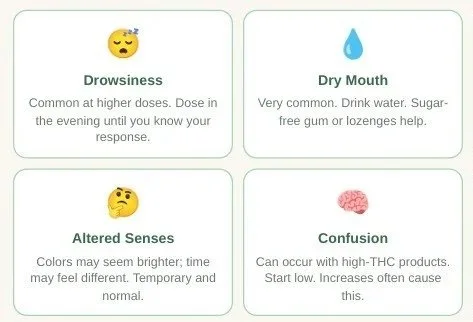
Drowsiness is common — particularly at higher doses and with THC-dominant products. If you experience drowsiness, dose in the evening until you understand how your body responds. Never drive or operate machinery if you feel drowsy after using cannabis.
-
Dry mouth is one of the most common side effects of cannabis use. Drinking water regularly helps. Sugar-free gum or lozenges can also provide relief. This side effect typically decreases as your body adjusts to cannabis.
-
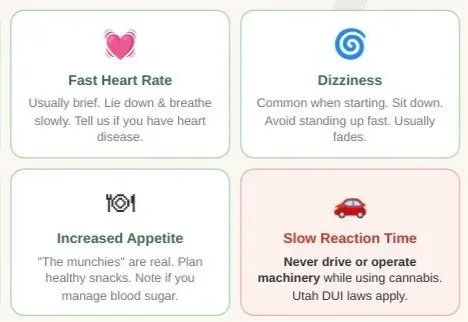
A temporarily elevated heart rate is common — particularly when starting cannabis or using higher-THC products. It is usually brief and resolves on its own. If you experience a fast heart rate, lie down, breathe slowly, and rest. If you have a history of heart disease, discuss this with Dr. Law before starting cannabis.
-
Dizziness is most common when starting cannabis or increasing your dose. If you feel dizzy, sit down and avoid standing up quickly. This side effect typically fades as your body adjusts. Starting with a very low dose significantly reduces the likelihood of dizziness.
-
Some patients notice that colors appear brighter or that time feels different when using cannabis — particularly with THC-dominant products. This is temporary and normal. It will pass as the effects of the cannabis wear off.
-
Confusion and cognitive cloudiness can occur — particularly with high-THC products or when doses are increased too quickly. If you experience confusion, reduce your dose and increase more slowly. This is one of the most common reasons we recommend starting at the lowest possible dose.
-
Increased appetite — sometimes called "the munchies" — is a well-known effect of THC. For some patients this is actually a desired therapeutic effect. If you are managing blood sugar or weight, plan ahead with healthy snack options.
-
Cannabis impairs reaction time and coordination — even when you don't feel noticeably impaired. This is one of the most important safety considerations for medical cannabis patients.
Never drive or operate heavy machinery while using medical cannabis. Utah DUI laws apply to medical cannabis patients.

Conditions requiring extra caution
Medical cannabis may not be appropriate for all patients. The following conditions require careful discussion with Dr. Law before starting cannabis:
Click arrow to expand
-
Cannabis crosses the placenta and may affect fetal development. Medical cannabis should be avoided entirely during pregnancy. If you are pregnant or planning to become pregnant, discuss this with Dr. Law before your evaluation.
-
Cannabinoids are present in breast milk. Experts recommend avoiding medical cannabis entirely while breastfeeding. Discuss alternatives with Dr. Law if you are breastfeeding and seeking symptom relief.
-
Cannabis raises heart rate and blood pressure — effects that may be significant for patients with underlying cardiovascular conditions. If you have a history of heart disease, heart attack, arrhythmia, or uncontrolled high blood pressure, discuss the risks carefully with Dr. Law before starting cannabis.
-
Cannabis — particularly high-THC products — can worsen symptoms of psychosis and schizophrenia. If you or a first-degree family member has a history of psychosis or schizophrenia, medical cannabis may not be appropriate. Dr. Law will discuss this carefully at your evaluation.
-
Research suggests that cannabis use during adolescence and early adulthood may affect brain development. Medical cannabis in patients under 21 requires particularly careful evaluation and should involve parents or guardians in the discussion.

Drug interactions
Cannabis interacts with a number of common medications through the liver's cytochrome P450 enzyme system — the same pathway used by many prescription drugs. These interactions can cause medications to become stronger or weaker than intended.
Always tell every doctor, dentist, pharmacist, and healthcare provider that you use medical cannabis — including at urgent care visits, ER visits, and before any surgical procedure.
-
Cannabis can significantly increase warfarin's blood-thinning effect. If you take warfarin, you will need more frequent INR monitoring after starting cannabis.
-
Used for epilepsy; cannabis can increase clobazam blood levels
-
Cannabis may affect citalopram metabolism
-
Used for circulation; interaction possible
-
Blood thinner; use with caution
-
Combining cannabis and alcohol significantly amplifies impairment. Avoid combining.
-
Cannabis adds to sedative effects; combination can cause excessive drowsiness
-
Some antihistamines combined with cannabis can cause significant drowsiness
-
Cannabis affects how much anesthesia you need. Always tell your anesthesiologist before any procedure.
Check for interactions between cannabis and your specific medications at: drugs.com/drug-interactions
Always tell your provider before:
Starting any new medication
Having any surgical or dental procedure
Visiting an emergency room or urgent care
Starting or stopping cannabis use

Safe use rules every patient should follow
Start low and go slow
Always begin with the lowest possible dose — typically 2.5–5mg THC or your pharmacist's recommendation. Increase gradually over days, not in a single session. This is the single most important rule for safe cannabis use.

Wait the full time before re-dosing
Edibles and capsules: wait at least 2 hours before taking more
Tinctures: wait at least 30–45 minutes
Vaporized products: effects are felt within minutes
The most common cannabis overconsumption incidents occur when patients re-dose edibles too soon because they don't feel effects yet. Always wait the full time.

Storage
Keep cannabis in its original child-resistant packaging
Store out of sight and reach of children
Never remove warning labels
Treat it like any prescription medication — secure and private
No driving
Never drive or operate machinery while using cannabis. Effects can last several hours. Plan transportation in advance. Utah DUI laws apply fully to medical cannabis patients — a valid card does not protect you from DUI charges.

Track your use
The Utah DHHS provides a free Patient Tracking Journal to help you log products, doses, and how you feel. Download it free at medicalcannabis.utah.gov/info or ask us for a printed copy. Bring it to every follow-up appointment — it helps Dr. Law make better recommendations.

When to call us
Contact Progressive Primary Care if you experience:
Severe or unexpected side effects
Significant changes in your symptoms
You start a new medication
Before any surgery or procedure
Questions about your dose or products
📱 (801) 571-0796 — call or text
✉️ help@progressiveprimary.care

When to seek emergency care
Call 911 or go to your nearest emergency room if you experience:
Severe chest pain or irregular heartbeat
Extreme confusion or loss of consciousness
Difficulty breathing
Severe anxiety or panic that will not subside
Suspected cannabis overconsumption in a child

Understanding THC vs. CBD
THC (Tetrahydrocannabinol)
THC is the primary psychoactive compound in cannabis. It creates the "high" associated with cannabis use and is responsible for many of its therapeutic effects — including pain relief, muscle relaxation, nausea reduction, and appetite stimulation. THC is detected on drug tests. High doses can cause anxiety, confusion, and paranoia in some patients — starting low is essential.
CBD (Cannabidiol)
CBD is non-intoxicating — it does not cause a high. It has anti-inflammatory, anti-anxiety, and anticonvulsant properties and is generally very well tolerated. CBD can also reduce some of the anxiety-producing effects of THC when the two are combined. CBD is the basis of the only FDA-approved cannabis-derived medication currently on the market (Epidiolex, for severe epilepsy).
🔗 NIH — Understanding Cannabinoids
Ready to schedule your evaluation?
Dr. Law reviews all safety considerations personally with every patient at their evaluation. If you have questions about how medical cannabis might interact with your current medications or health conditions, the best next step is a conversation with him directly.
Same-day appointments often available. New cards must be obtained with an in-person appointment, renewals can be done in person or virtually.
📞 Call or text: (801) 571-0796
✉️ help@progressiveprimary.care
📍 9844 South 1300 East, Suite 125, Sandy, UT 84094
Continue reading: the complete patient guide
This is part 1 of Dr. Law's 4-part medical cannabis patient education series.
Part 1: Getting Started: Your 9-Step Journey to Your Card
Part 3: Products, Dosing & What to Expect
Part 4: Your Rights, Legal Protections & Resources
Part 5: Understanding Utah Qualifying Conditions